The Heirs of Annie Ernaux
30 novembre 2026
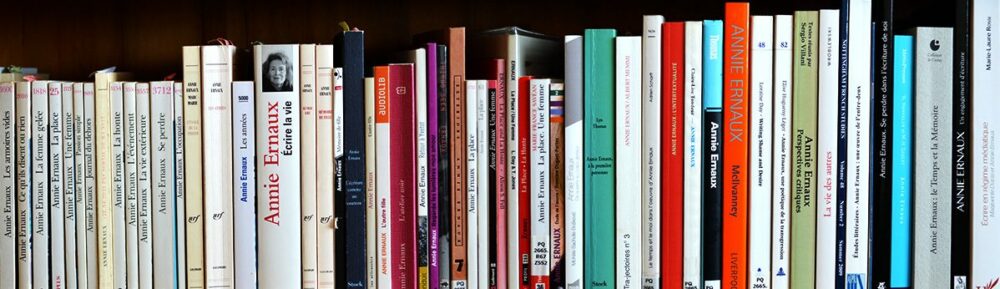
Annie Ernaux International Studies, Volume #3
We are preparing an edited volume that will explore the multiple legacies of the 2022 Nobel Prize in Literature laureate, Annie Ernaux. In what ways do writers, visual artists, and filmmakers inherit from and reimagine Ernausian themes, approaches, poetics, and aesthetics?
We are seeking proposals for scholarly chapters as well as non-traditional, creative submissions. All proposals should make clear reference to the elements of Ernaux’s work that are being “inherited” and they should study either a single Ernausian “heir” or multiple “heirs” through a comparative lens. We are interested in chapters focusing on practitioners from across the world, and not only those from anglophone and francophone spheres, although the volume will be published in English. Contributors are encouraged to adopt a broad view of the notion of “inheritance,” which may apply to individuals of a succeeding generation (“vertical” genealogy) as well as those of the same generation (“horizontal” genealogy). Inheritance may, furthermore, be understood as a dialogue between generations for, as Françoise Collin writes (82), inheritance often occurs bilaterally – through relationality and exchange. All contributors should consider how the act of inheritance necessitates a degree of transformation or evolution, shaped by the spatial, temporal, cultural, social, and political differences that distinguish Ernaux from her heirs. In this sense, we envisage inheritance in the terms that Evelyne Ledoux-Beaugrand develops (25), namely as an opening to alterity, difference, and newness. Inheritance need not be understood as a deliberate act, since an heir may unintentionally borrow or rework Ernausian themes, tropes, and approaches. Ernaux’s work has enjoyed a global reception and impacted the ways readers across the globe think about art, society, politics, gender, the body and more; it is therefore inevitable that her contributions have both directly and indirectly influenced other practitioners. Furthermore, inheritance need not imply agreement with or praise of Ernaux’s work. What, for instance, does it mean to be the bearer of a troublesome, difficult, or unwanted inheritance? Is it possible to work against the process of inheritance? To again cite Collin, “filiation is the art of holding onto a thread and breaking a thread” (83). Similarly, Ledoux-Beaugrand (25) writes that “an inheriting posture” involves a “process of sorting” characterised by both continuity and rupture. Finally, we invite contributors to engage not only with “successful” or reparative forms of inheritance, but to explore “unsuccessful,” oppositional, and even superficial engagements with Ernaux’s legacy. The following thematic axes are four among many possible approaches to this topic, and they provide only a few potential starting points for responses to this call for proposals. Please let us know if your contribution fits within one of these themes, or whether you would like to propose another. […]
Submission guidelines
Please send proposals via this online form by Monday 30 November 2026: https://forms.office.com/r/ep4MvEXmEb. You may direct questions to the volume editors, Beth Kearney (b.kearney@uq.edu.au) and Alexandra Pugh (alexandra.pugh@queens.ox.ac.uk).
All contributions will be in English, and English translations of all foreign language material should be provided. The exception here is creative contributions, which may be multilingual depending on the aims, scope, and ambition of the piece. Chapters are expected to be 5,000-6,500 words in length.
Project Timeline
· Submissions due: Monday 30 November 2026
· Notification of the editors’ decisions on chapters: January 2027
· Full chapters due: May 2027
· Peer review: May-November 2027
· Publication: 2028